South Korea · City guide
Seoul travel guide
Start a Seoul visit with a palace, a neighbourhood walk and a meal rather than a cross-city checklist. Gyeongbokgung introduces the Joseon royal story; Bukchon adds traditional homes, while Insadong offers a different angle through crafts. This guide suggests six outings and five dishes, with airport-transfer choices and a month-by-month climate table to help shape your plans. Treat the suggested groupings as flexible itinerary ideas, not a promise that every stop fits one day.
Get to know Seoul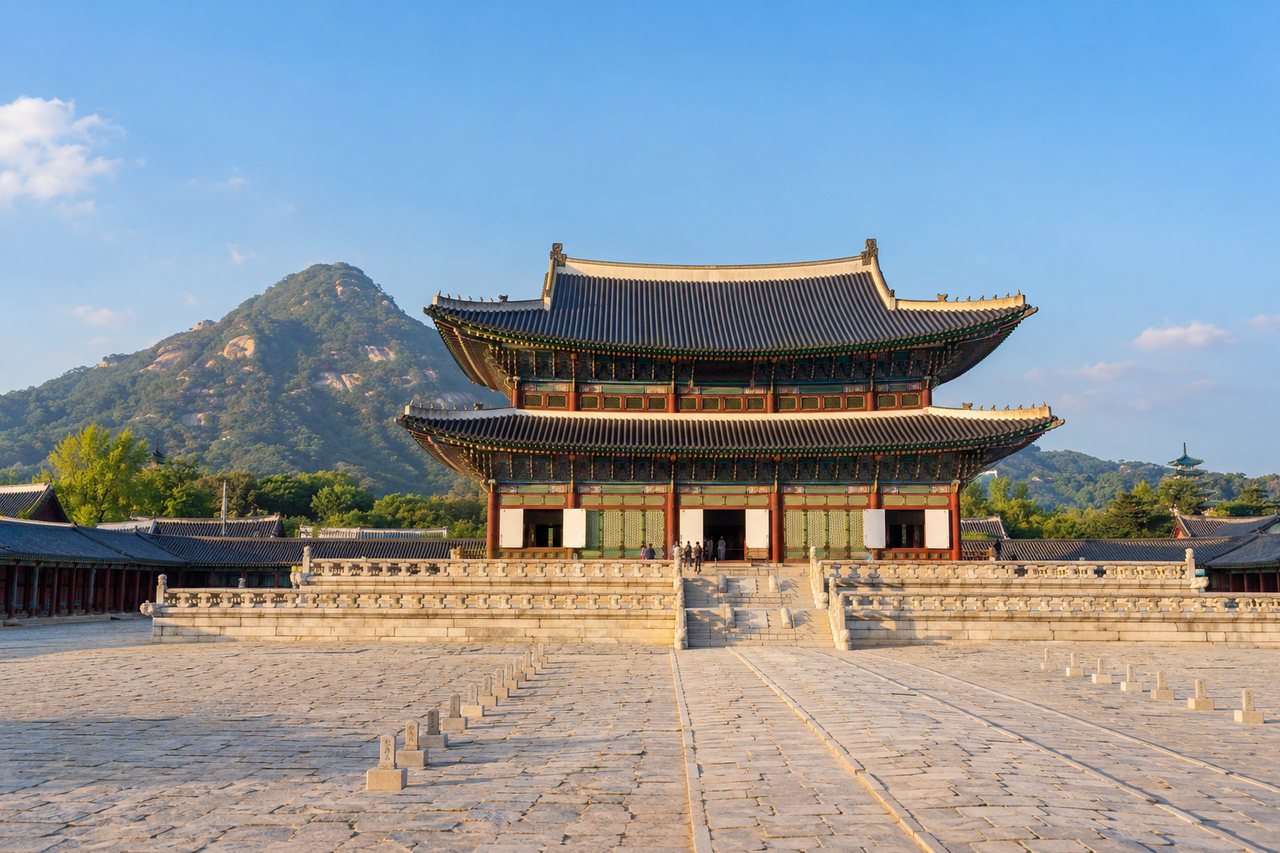
In this guide 8 sections
Go a little further
Best Things to Do in Seoul
Gyeongbokgung Palace
Established in 1395 as the main palace of the Joseon dynasty, Gyeongbokgung is a useful starting point for a history-focused visit. Our suggestion is to give the palace its own unhurried outing rather than squeeze it between meals and shopping. Check the official visitor information again before going: this guide does not promise particular opening hours, night access or a ceremony on your date.[1]
National Folk Museum of Korea
The National Folk Museum focuses on everyday Korean life through the ages. Consider it a companion to the palace: compare the museum’s account of daily life with the royal history at Gyeongbokgung. This is a suggested theme for your visit, not a claim about the current displays. Confirm the current exhibitions and visitor arrangements separately before planning around a particular collection.[2]
Bukchon Hanok Village
Bukchon is known for hanok, traditional Korean homes. It offers a contrasting subject after the palace: domestic architecture rather than royal buildings. Our suggestion is a short, attentive walk rather than a photography circuit with a long shot list. Keep voices low, avoid blocking doorways and follow posted access instructions. These are visitor-etiquette recommendations, not a claim that every lane is open to visitors.[2]
Insadong
Visit Seoul recommends Insadong for traditional Korean culture and handicrafts. Choose it if browsing crafts appeals more than adding another monument. Ask about an item’s maker and materials before buying; a shop’s location is not itself proof of an object’s provenance or age.[2]
Gwangjang Market
Visit Seoul describes Gwangjang as over a century old and recommends trying foods such as mung bean pancakes. Look around before choosing a meal, and start with one dish if you want to try several stalls. Check ingredients directly and apply the food-safety advice below; a busy market is not a hygiene guarantee.[2]
Namsan Seoul Tower
The tower’s observatory offers broad city panoramas, according to Visit Seoul. Consider it a different kind of outing from the palace and traditional neighbourhoods: a chance to understand the city from above. Our suggestion is to check conditions before committing to a view-focused visit, and to keep a different plan available if visibility disappoints. Observatory access, transport arrangements and ticket conditions need checking for your actual date.[2]
A taste of the city
What to Eat and Where
Rice dish
Bibimbap
Bibimbap combines rice with vegetables and may include meat. Visit Seoul notes that the ingredients determine whether a version is meat-based or vegetarian. Do not assume a vegetable-looking bowl meets your dietary requirements: ask about the full ingredients and sauce before ordering.[3]
Check directly with the chosen venue
Korean pancake
Jeon
Jeon is a Korean pancake with variants including green onion and kimchi. Treat the name as a category, not a fixed recipe. Our suggestion is to ask what the particular version contains before sharing a plate, especially if anyone in your party has allergies.[3]
Check directly with the chosen venue
Rice-cake dish
Tteokbokki
Tteokbokki uses rice cakes in a chili-paste sauce; Visit Seoul describes an earlier version made with beef and soy sauce. That historical description does not establish what a particular stall serves today. Ask about the sauce and ingredients rather than assuming the name guarantees a particular heat level. Consider a small first order if the dish is new to you.[3]
Check directly with the chosen venue
Ginseng chicken soup
Samgyetang
Samgyetang is chicken soup made with ginseng, glutinous rice, garlic and other ingredients. Consider it for a sit-down meal, and ask about the serving and ingredients at your chosen restaurant. No particular venue or booking availability is endorsed here.[3]
Check directly with the chosen venue
Shaved-ice dessert
Patbingsu
Patbingsu combines shaved ice with sweetened red beans and toppings. Visit Seoul describes the earlier combination of red beans, rice cake and milk, alongside newer toppings including fruit and ice cream. Check the actual ingredients before ordering, and remember that safe water matters for ice as well as for drinks.[3][5]
Check directly with the chosen venue
Set your own pace
Plan your stay
Match the airport train to your destination
From Incheon, AREX Express runs non-stop to Seoul Station, while the All-Stop service serves stations including Hongik University and Digital Media City. Choose by your final destination rather than by the train name alone. Airport limousine buses and taxis are alternatives. Check the current terminal, last service and onward route before arrival; this guide deliberately does not reproduce fares or timetables.[4]
Check whether your flight uses ICN or GMP
Incheon and Gimpo are different airports. Korea Tourism Organization describes Airport Railroad and subway options from Gimpo as well as Incheon’s transfer choices. Read the airport and terminal on your ticket before planning transport. Our suggestion is to save your accommodation’s address and a fallback transfer option before departure rather than assume the same arrival plan works at both airports.[4]
Build an itinerary around interests
For a first visit, our suggested pairing is royal history at Gyeongbokgung with everyday life at the National Folk Museum. Give crafts in Insadong, market food at Gwangjang and the tower panorama separate consideration rather than promising all six attractions in one day. Decide what to drop before adding another stop; these are editorial groupings, not a timed walking route.[1][2]
Before you travel
Travel Health
Review routine immunizations with a qualified travel-health professional before departure. Türkiye’s South Korea guidance discusses hepatitis A in relation to contaminated food and water, and makes some other vaccine advice dependent on the itinerary. In particular, Japanese encephalitis advice considers length of stay, season and rural or outdoor exposure; do not apply a longer rural trip’s advice automatically to a short Seoul stay. WHO’s food-safety guidance emphasizes cleanliness, separating raw and cooked food, thorough cooking, safe temperatures and safe water. Use these principles when choosing meals, not a blanket assumption that all market food is either safe or unsafe. This is general planning information, not a prescription, diagnosis or assessment of your personal risk. Read the linked authorities again before travel and seek individual advice. The Turkish page includes older dated material, so this review does not establish current entry requirements or certify the absence of outbreaks.[5][6]
Find your season
Weather Through the Year
Historical climate normals, not a forecast.[7]
| Month | Avg high | Avg low | Rain | Travel note |
|---|---|---|---|---|
| Jan | 2.1 °C | -5.5 °C | 16.8 mm | Packing suggestion: insulated layers for freezing nights. |
| Feb | 5.1 °C | -3.2 °C | 28.2 mm | Packing suggestion: retain winter layers. |
| Mar | 11 °C | 1.9 °C | 36.9 mm | Packing suggestion: layers for cool mornings. |
| Apr | 17.9 °C | 8 °C | 72.9 mm | Packing suggestion: a light outer layer and rain protection. |
| May | 23.6 °C | 13.5 °C | 103.6 mm | Packing suggestion: lighter daytime clothing with a spare layer. |
| Jun | 27.6 °C | 18.7 °C | 129.5 mm | Packing suggestion: rain protection for outdoor plans. |
| Jul | 29 °C | 22.3 °C | 414.4 mm | Planning suggestion: keep indoor alternatives for rainy days. |
| Aug | 30 °C | 22.9 °C | 348.2 mm | Planning suggestion: carry rain protection and allow indoor breaks. |
| Sep | 26.2 °C | 17.7 °C | 141.5 mm | Packing suggestion: light layers and rain protection. |
| Oct | 20.2 °C | 10.6 °C | 52.2 mm | Packing suggestion: a layer for cooler evenings. |
| Nov | 11.9 °C | 3.5 °C | 51.1 mm | Packing suggestion: warmer layers for mornings and evenings. |
| Dec | 4.2 °C | -3.4 °C | 22.6 mm | Packing suggestion: winter clothing for subzero nights. |
Best Time to Visit
For a walking-focused trip, consider April–May or October: the Seoul normals show milder days than winter and less rainfall than July–August. October averages a 20.2°C daily maximum and 52.2 mm of precipitation; January averages a −5.5°C daily minimum. July and August have the largest monthly rainfall totals in this table. These are 1991–2020 station averages, not a forecast, flowering calendar or guarantee of clear views. Check current conditions before travelling.[7]
Make it a journey
Current fares to Seoul
BEST DIRECT FARE28% belowBarcelona (BCN) to
Seoul (ICN)
Round trip13 Jan – 27 Jan14 days
From €747.00
Nonstop both ways12h 20m out · 14h 55m back
RECENTLY FOUNDHelsinki (HEL) to
Seoul (ICN)
Round trip12 Apr – 19 Apr7 days
From €831.00
Nonstop both ways11h 50m out · 13h 40m back
RECENTLY FOUNDLondon (LON) to
Seoul (ICN)
Round trip8 Feb – 23 Feb15 days
From £670.00
Nonstop both ways12h 30m out · 14h 55m back
RECENTLY FOUNDLos Angeles (LAX) to
Seoul (ICN)
Round trip10 Dec – 19 Dec9 days
From US$1,047.00
Nonstop both ways13h 35m out · 11h 10m back
RECENTLY FOUNDSydney (SYD) to
Seoul (ICN)
Round trip5 Jan – 12 Jan7 days
From A$1,828.00
Nonstop both ways11h out · 10h 15m back
RECENTLY FOUNDVancouver (YVR) to
Seoul (ICN)
Round trip30 Mar – 9 Apr10 days
From CA$1,429.00
Nonstop both ways11h 20m out · 9h 50m back
Flight routes to Seoul
A few useful answers
Frequently asked questions
How should I organize a first Seoul visit?
Start with your priorities rather than a fixed number of must-sees. Our suggestion is to group Gyeongbokgung and the National Folk Museum as a history-and-daily-life theme, then choose separately between crafts in Insadong, food at Gwangjang and a tower panorama. Leave space to change the order instead of treating this as a timed route.[1][2]
Which train should I take from Incheon airport?
AREX Express runs non-stop to Seoul Station; All-Stop serves intermediate stations including Hongik University and Digital Media City. Compare the onward journey to your accommodation before choosing. Recheck current services and your arrival terminal with the operator; a non-stop ride to Seoul Station is not automatically the simplest door-to-door route.[4]
When is Seoul less rainy for sightseeing?
In the Seoul station’s 1991–2020 normals, July and August have much higher rainfall totals than April, May or October. October is our suggested starting point for comparing a walking-focused trip, not a promise of dry weather. Winter has lower precipitation but much colder temperatures. Use the monthly table alongside an actual forecast.[7]
Is bibimbap always vegetarian?
No. Visit Seoul describes bibimbap as either meat-based or vegetarian depending on the ingredients. Ask about the particular bowl, including sauces and toppings, rather than rely on its name. Other dishes here also have variable fillings or versions; confirm your requirements directly with the venue before ordering.[3]
Stay curious
Keep exploring
Behind the guide
Sources and editorial checks
Fact check: 2026-10-25. Food check: 2026-10-25. These are editorial checks, not a claim of a first-person visit. Suggested routes and time allocations are planning judgments.
- Visit Seoul: Gyeongbokgung Palace · accessed 2026-10-25
- Visit Seoul: Korean Culture in 6 Days · accessed 2026-10-25
- Visit Seoul: The best foods to eat in Seoul · accessed 2026-10-25
- Korea Tourism Organization: Airport Transportation Guide · accessed 2026-10-25
- WHO: Promoting safe food handling · accessed 2026-10-25
- Türkiye travel-health authority: South Korea · accessed 2026-10-25
- WMO WWIS / Korea Meteorological Administration: Seoul climate normals · accessed 2026-10-25
- Wikimedia Commons: Downtown Seoul skyline · accessed 2026-10-25
- Research access record: wmo · accessed 2026-10-25 · discovery/access only; not used as verified evidence
- Research access record: stream · accessed 2026-10-25 · discovery/access only; not used as verified evidence
- Research access record: namsan · accessed 2026-10-25 · discovery/access only; not used as verified evidence
- Research access record: airport · accessed 2026-10-25 · discovery/access only; not used as verified evidence
- Research access record: who · accessed 2026-10-25 · discovery/access only; not used as verified evidence
- Research access record: wmo-city-list · accessed 2026-10-25 · discovery/access only; not used as verified evidence
- Research access record: seoul-transport · accessed 2026-10-25 · discovery/access only; not used as verified evidence
- Research access record: video-palace · accessed 2026-10-25 · discovery/access only; not used as verified evidence
- Research access record: video-stream · accessed 2026-10-25 · discovery/access only; not used as verified evidence
- Research access record: video-market · accessed 2026-10-25 · discovery/access only; not used as verified evidence
- Research access record: captions-palace · accessed 2026-10-25 · discovery/access only; not used as verified evidence
- Research access record: captions-stream · accessed 2026-10-25 · discovery/access only; not used as verified evidence
- Research access record: captions-market · accessed 2026-10-25 · discovery/access only; not used as verified evidence

On-location video candidates were recorded, but usable captions were unavailable for this edition. No video observations are claimed.